 By
By
Organizations invest in Enterprise Asset Management expecting a step change in maintenance performance. Many of those programs stall, and usually not at the pilot site. They stall somewhere between site three and site thirty. When you look closely at why, the answer is rarely the software.
EAM sits where physical operations, people, asset data, maintenance processes, and a web of enterprise systems meet. Scaling EAM means scaling all of them at once. Our new white paper, Why Enterprise Asset Management Is So Hard to Scale, puts it as a simple equation:
EAM scaling = software + data + process + organization + integration
The first term is usually the easiest. The other four decide the outcome.
Data comes first. Sites built or acquired at different times use different naming conventions, hierarchies, equipment IDs, and classification schemes. Until that data is standardized and governed, every new site adds inconsistency rather than insight. Connected assets make it worse: telemetry from thousands of devices is only useful when it's tied to a common asset model.
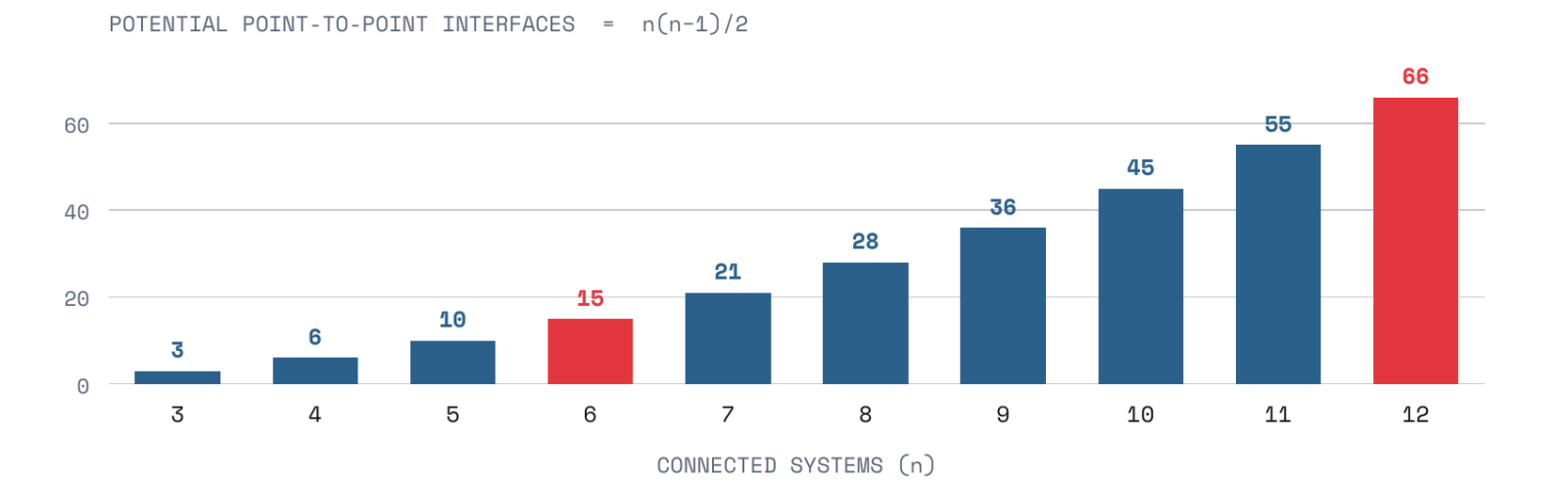
Integration grows faster than you'd expect. EAM exchanges information with ERP, finance, HR, GIS, SCADA/OT, IoT platforms, and mobile tools. Six connected systems can mean 15 potential point-to-point interfaces, and twelve can mean 66, before you multiply by sites. That's why every shared data object needs an explicit system of record. Someone has to decide who owns the equipment master, the part number, and the work order status.
Process variation becomes technical debt. When each site's way of working is preserved through customization, the implementation feels successful. Then the next upgrade or site rollout arrives. Configuring software before standardizing processes is one of the most common failure patterns in EAM implementations.
People determine whether the data is real. Technicians may not record work, planners may not maintain schedules, and supervisors may bypass workflows. When that happens, the system of record is incomplete even though the software runs perfectly.
The hardest transition isn't from "no system" to "installed system." It's from "we installed an EAM system" to "the enterprise actually operates through it."
What successful programs do differently
Six practices recur in large-scale programs that succeed:
- a common asset and data model
- standardized core processes
- clear system-of-record ownership
- a deliberate integration architecture
- sustained governance
- phased rollout
None of them requires more servers or licenses. All of them require treating EAM as an operating-model change rather than a software deployment.
Download the white paper for the full framework. It covers all nine scaling challenges, a sample system-of-record matrix, and a guide to mitigating the failure modes in each dimension.