 By
By
Why DIME Redefines What a Data Translator Can Do
From basic data pipes to AI-driven intelligence, what happens when AI is designed in from the start.
The Data Translator That Thinks
In Part 1, we established that traditional industrial data translators, Kepware, MatrikonOPC, and others were built to solve the protocol problem. They succeeded. But solving the protocol problem is table stakes now. The manufacturers winning in 2026 and beyond are not just the ones who can move data. They are the ones whose data works for them while it moves.
DIME (Data In Motion Enterprise) was designed around a fundamentally different premise: that the data translator should be the smartest component in your industrial stack, not the most passive. Every architectural decision, from its YAML-based configuration engine to its neuromorphic AI core, reflects that philosophy.
This is not a traditional translator with AI bolted on. It is a solution built from the ground up to integrate, transform, learn, and act, all in real time, all in one place.
1. Configuration That Builds Itself
The single biggest frustration with platforms like Kepware is not the protocol support, it is the implementation tax. Every new machine, every new tag, every new integration requires manual configuration work by someone who understands both the industrial protocol and the platform's configuration model. That person is expensive, their time is limited, and their work produces a proprietary artifact that no one else can easily read or modify.
DIME solves this with an AI-configurable architecture grounded in human-readable YAML. Instead of navigating a proprietary GUI to map tags manually, a DIME user simply describes what they need in plain language:
"Create a configuration for a simulated 3-axis CNC machine, sink the data to an embedded MTConnect Agent, output to a WebSocket, and build a JavaScript UI to visualize it within DIME."
DIME's AI generates the complete YAML configuration, connector definitions, data mappings, transformation logic, and monitoring dashboards automatically. What would have taken a Kepware specialist several days takes minutes.
Crucially, the result is infrastructure as code. The YAML configuration lives in version control and can be reviewed, tested, and deployed with the same discipline as software. When you need to add a machine or migrate a plant, AI can translate an existing Kepware server export into a native DIME configuration automatically, no manual rebuild required.
2. A Platform That Learns While It Works
This is the defining capability no traditional translator can replicate. DIME includes a built-in Hierarchical Temporal Memory (HTM) engine, a neuromorphic AI system inspired by how the human brain processes and predicts temporal sequences.
Here's what that means in practice. When Kepware delivers a spindle load reading of 74.2, it delivers a number. When DIME delivers that same reading, it delivers a number plus context:
- Is this value anomalous relative to this machine's historical behavior?
- Does it fit the predicted pattern for this time of day, this product run, this operator?
- Is there a temporal sequence forming that historically precedes a failure event?
The HTM engine answers these questions continuously and automatically, without a data scientist, without model retraining, and without manual threshold configuration. It learns on the stream. When your process changes, seasonally, after maintenance, when a new product run begins, HTM adapts in real time. Static ML models and threshold-based alerts require manual updates to keep pace with a changing process. DIME's HTM just keeps learning.
What continuous learning delivers:
- Anomaly detection that distinguishes genuine problems from normal process variation
- Predictive signals before equipment fails, not just alerts after thresholds are crossed
- Explainable results, operators can understand why an anomaly was flagged, not just that it was
- Self-adapting baselines that evolve with your process, eliminating alarm fatigue
The result is measurable. DIME users have documented a 50% reduction in unplanned downtime and a 25% improvement in Overall Equipment Effectiveness. These outcomes are not achievable from a platform that only moves data.
 3. One Solution, Not Five
Perhaps the most underappreciated advantage of DIME over traditional translators is what it replaces. A typical Kepware-based stack looks something like this:
Kepware (collection) → Historian (storage) → SCADA (visualization) → 3rd-party AI tool (analytics) → Separate dashboard (platform health)
Each of these systems carries its own license, its own integration, its own failure mode, and its own support contract.
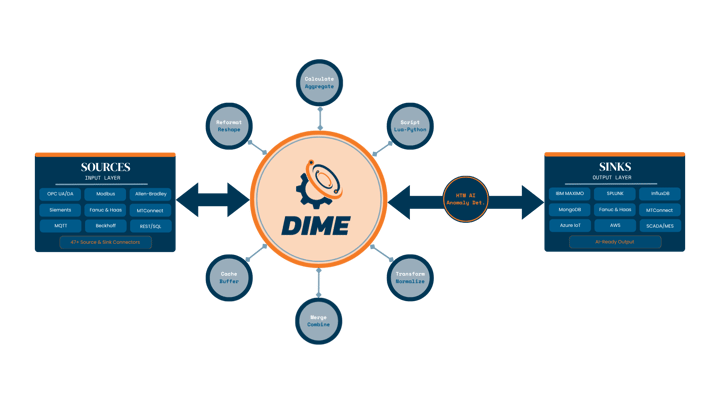
DIME collapses that stack and ecosystem. A single deployment provides:
- 47+ native industrial connectors: OPC-UA, Modbus, Ethernet/IP, MQTT, SparkplugB, MTConnect, Fanuc, Haas, Beckhoff, Siemens S7, IBM Maximo, and more
- Real-time data transformation: built-in Python and Lua scripting, unit conversions, normalization, business logic, and cross-connector correlation, all in-flight
- HTM-powered analytics: continuous anomaly detection and predictive intelligence running on the live data stream
- Interactive dashboards: real-time trend analysis, OEE calculation, and production intelligence
- Enterprise management portal: connector health, message flow rates, and system performance at a glance
- Flexible deployment: Windows service, Docker container, embedded, cloud, on-premises, or hybrid
The cost implications are significant. DIME's pricing is a fraction of a comparable enterprise deployment.
4. Escape the Lock-In
Traditional platforms create lock-in through complexity. Years of manually configured OPC tags, stored in a proprietary binary format, represent a switching cost that keeps customers paying license fees long past the point where they'd otherwise evaluate alternatives.
DIME's approach is the opposite. YAML configurations are open, portable, and readable by any developer or AI tool. They live in your version control system, not in a vendor's proprietary database. If you decide to change how you deploy or expand your integration, your configuration comes with you.
For customers migrating from Kepware or MatrikonOPC, DIME's AI migration capability turns what would otherwise be a months-long rebuild into a matter of days. AI parses the existing platform export and generates an equivalent DIME configuration, preserving tag hierarchies, update rates, and data type mappings automatically. The migration barrier that traditional vendors depend on simply doesn't exist with DIME.
5. A Platform Built for What's Next
Industrial AI isn’t coming. It’s here. Digital twins, predictive maintenance at scale, AI-generated production schedules, and autonomous quality control are becoming competitive the price of admission in manufacturing. Every one of these capabilities requires a data foundation that can connect everything, understand the context of what it is collecting, and adapt to changing conditions in real time.
Traditional data translators were designed for an era when the goal was simply getting the data somewhere. DIME was designed for an era when the goal is to make the data mean something immediately, automatically, and continuously.
That's not an incremental improvement. It's a different category of solution. 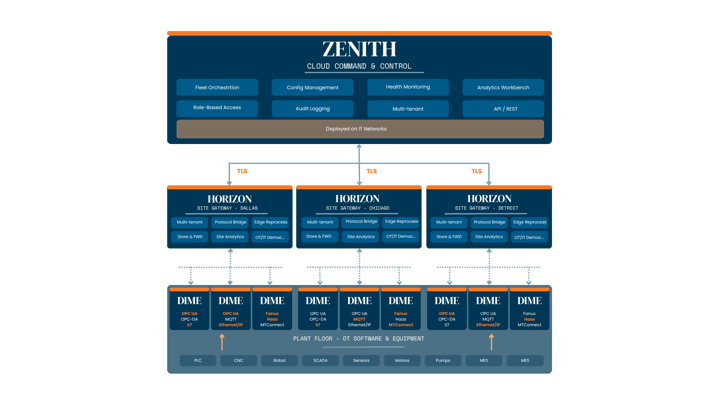 The Bottom Line
If your current industrial data stack relies on traditional data translators, you are not using a bad product. You are using a product designed for a different era. Those platforms solved a real problem, and they solved it well.
But the manufacturing intelligence challenge of 2026 is larger than protocol translation. It's about having a platform that connects everything, configures in hours, learns from the data it moves, and grows smarter without requiring constant intervention from data scientists and integration specialists.
That platform is DIME. And the best time to see it in action is before your competitors do.
Ready to see DIME in action?
Schedule a live demonstration and watch AI generate a complete industrial data integration solution for your use case in minutes, not months.
Request a Demo or Try it for yourself with our free online demos